Follow OCI Power's progress through the latest news, resources, and project stories.
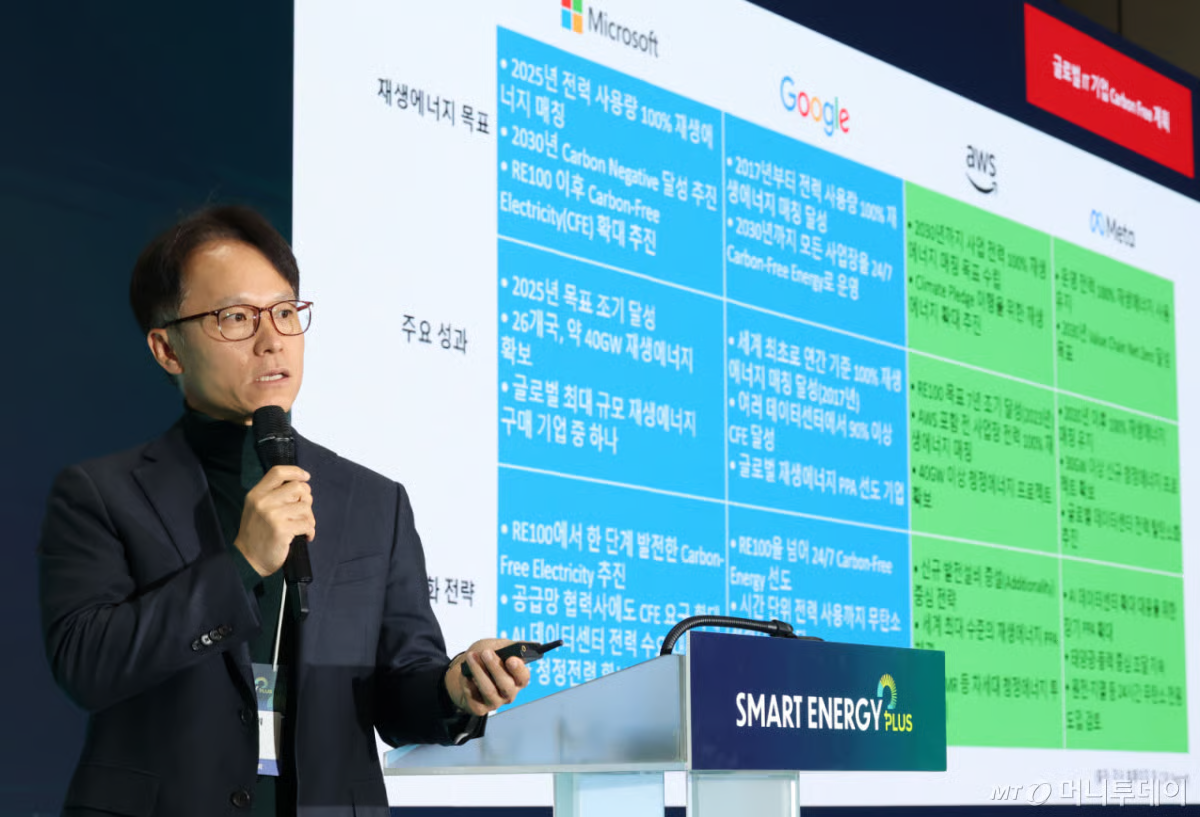
▲ Sung Yeop Kim, CEO of OCI Power, delivers a presentation titled “The Importance of Renewable Energy and BESS in AI Data Centers” at the AI Gold Rush – AIDC Power Grid session of Smart Energy Plus (SEP) 2026, held at COEX in Gangnam-gu, Seoul, on October 30. Photo by Lee Ki-beom.
“Battery energy storage systems (BESS) and power conversion technologies that control them will become key competitive advantages in addressing the intermittency of renewable energy and rapid fluctuations in electricity demand.”
Sung Yeop Kim, CEO of OCI Power, made these remarks at the AI Gold Rush conference held as part of Smart Energy Plus (SEP) 2026 on October 30 at COEX Hall B in Samseong-dong, Seoul.
Speaking on the topic of “The Importance of Renewable Energy and Battery Energy Storage Systems (BESS) in AI Data Centers,” Kim identified stable electricity supply and energy storage technologies as critical factors determining the competitiveness of AI data centers.
Kim noted that securing renewable energy is becoming an increasingly important competitive factor in the AI data center market.
“Global companies such as Microsoft and Google are moving beyond RE100, which focuses on sourcing 100% renewable electricity, toward the concept of Carbon-Free Energy,” he said.
“Going forward, major AI data center customers will place greater importance on whether operators can secure electricity through renewable energy sources and power purchase agreements (PPAs).”
However, the intermittency of renewable energy and fluctuations in AI data center electricity demand remain significant challenges.
Renewable energy generation varies depending on weather and environmental conditions. Solar power generation is concentrated during daylight hours, while wind power output fluctuates according to wind conditions.
At the same time, AI data centers experience substantial variations in electricity demand.
Servers powered by accelerators such as GPUs and NPUs repeatedly perform large-scale computations and communications, causing power consumption to fluctuate rapidly on a millisecond (ms) timescale.
“AI data centers consume large amounts of electricity when computational workloads begin, but power consumption can drop sharply during communication phases,” Kim explained.
“When these fluctuations occur repeatedly, they can affect voltage and frequency, potentially undermining power grid stability.”
Kim proposed battery energy storage systems as a potential solution to these challenges.
“In situations where data centers have been completed but cannot begin operations due to delays in electricity supply, BESS can help reduce the burden associated with power infrastructure development timelines,” he said.
“BESS can also store electricity when renewable energy generation is high and supply it to data centers when needed.”
He also pointed out that conventional battery systems alone may face limitations in responding to the rapid fluctuations in electricity demand experienced by AI data centers.
As an alternative, Kim introduced a hybrid ESS configuration combining ultracapacitors (supercapacitors) with lithium iron phosphate (LFP) batteries.
Unlike batteries, which store energy through chemical reactions, ultracapacitors store energy using an electric field.
Although they have relatively lower energy storage capacity, ultracapacitors offer the advantage of extremely fast charging and discharging, making them suitable for responding to sudden changes in power demand.
“Power loads in data centers fluctuate on a millisecond timescale, while conventional BESS have limitations in their charging and discharging speeds,” Kim said.
“A hybrid approach combining supercapacitors and LFP batteries could help address these rapid power fluctuations.”
Kim also emphasized the growing importance of power conversion system (PCS) technology.
He explained that beyond battery performance, technologies capable of reliably delivering stored electricity to power grids and data centers are equally important.
In particular, Kim identified grid-forming technology as a potential key technology for the future.
Grid-forming technology enables power conversion systems to independently regulate voltage and frequency rather than relying entirely on an external power grid.
“Batteries can be sourced from various suppliers, but the power conversion system connected to the battery serves as the brain of the entire system,” Kim said.
“Ultimately, securing not only battery technology but also power conversion and grid configuration technologies will be essential.”
Source: Money Today (머니투데이), October 30, 2026
Original Article: https://www.mt.co.kr/industry/2026/10/30/2026103015191147290


 List